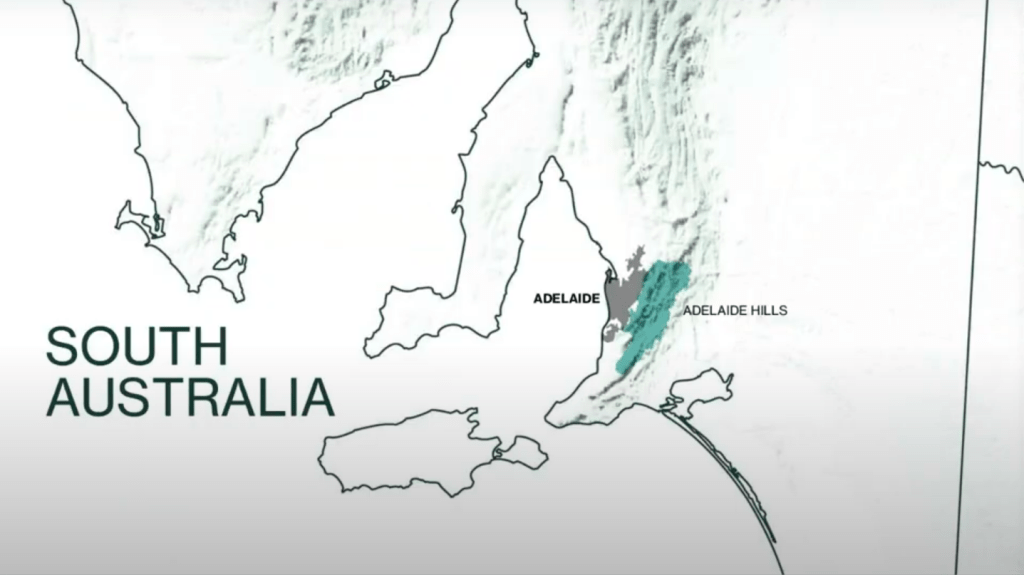
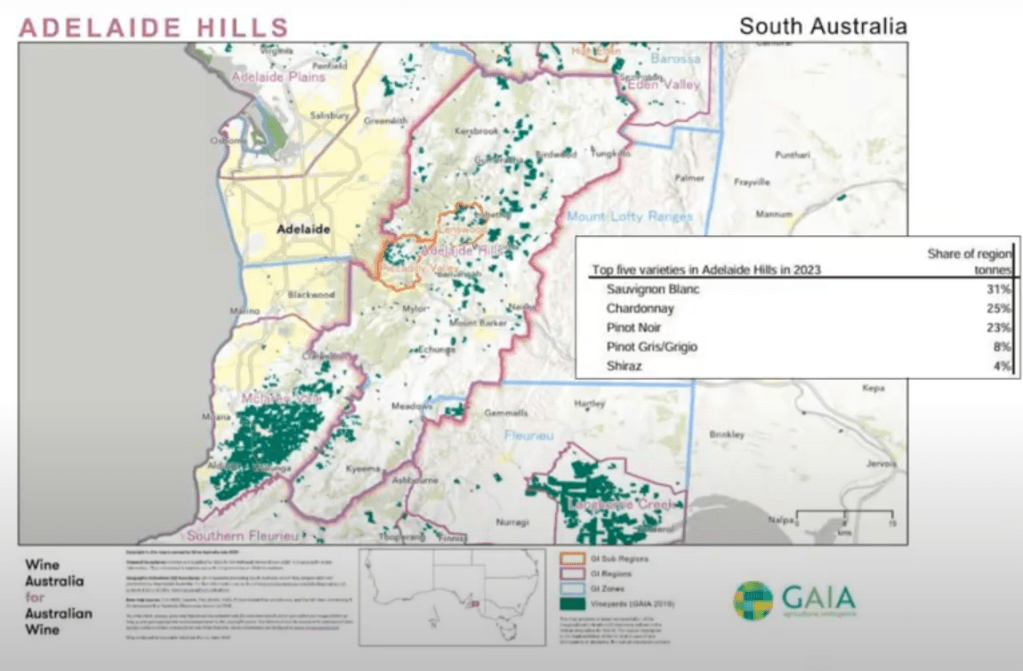
Now lets venture north towards Adelaide Hills which is also a cool climate althought it has more sunshine hours. This area still has the ocean factors of cooling sea breezes but not as much as Mornington Penninsula. What makes Adelaide Hills such a special place to grow Chardonnay is due to its evlavation. The central part can reach between 650-700m in altitude. This means cooler conditions and a large diurnal range where it can reach temperatures of 30 degress in the day and fall to 12 degrees at night. So it is key to select the correct vineyard inorder to either get an fresher/ light chardonnay or a fuller/ fattier chardonnay.
Low altitude, west facing slopes – Fuller/ Fattier Chardonnays
High altitude, higher diurnal ranges – Fresher/ Light Chardonnays
Adelaide Hills has two official sub regions that are at the highest altitude, Lenswood and Piccadilly Valley. Both areas reach up to 600m in altitude although Piccadilly Valley has lighter rainfall than Lenswood. Jimmy and Emma continued taking us on a journey through our different chardonnays focusing on these two regions.
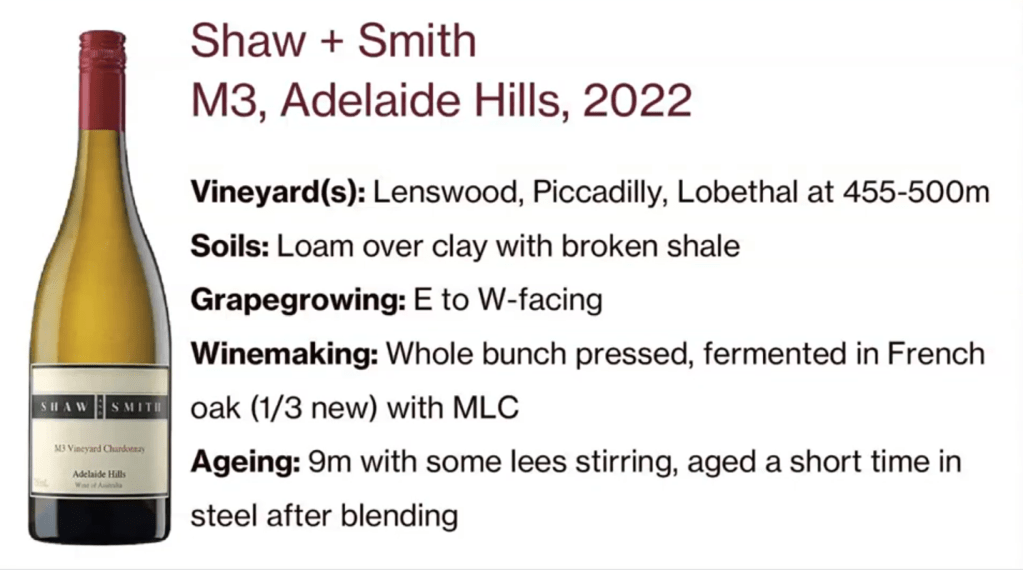
Shaw + Smith was established in 1989 by cousins Micheal Hill-Smith and Martin Shaw. ‘M3’ in the name of the wine includes Matthew who no longer works with the company. Their approach is to manage vineyard sustainably, valuing vine and soil health and low yields. This winery has gone through the change of different styles of chardonnays. 20 years ago, the vineyards were much lower down the hills so the wines were much richer and bolder. Then they moved up the hill 10 years later to achieve the delicate chardonnays we have today. The quality of these wines is exceptional especially at their price point. Jimmy uses this wine for his WSET3 and Diploma course. (I know as I have tried them).
Jimmy wanted to showcase a much younger wine that has potential for ageing. It was interesting to taste how much potential this wine has. Emma agreed that this wine was a similar style to the Kooyong, Farrago 2012 with a leaner, floral and mineral balance.
Petaluma was founded in 1976 which is built on their strong believes to carefully select the finest viticultural sites and the right grape varieties that suit the area. This vineyard is located in Piccadilly Valley which is nestled behind Mount Lofty which gives this wine in particular delicate/ light flavours with high acidity. This style of chardonnay is less new oak with a fresher and riper style.
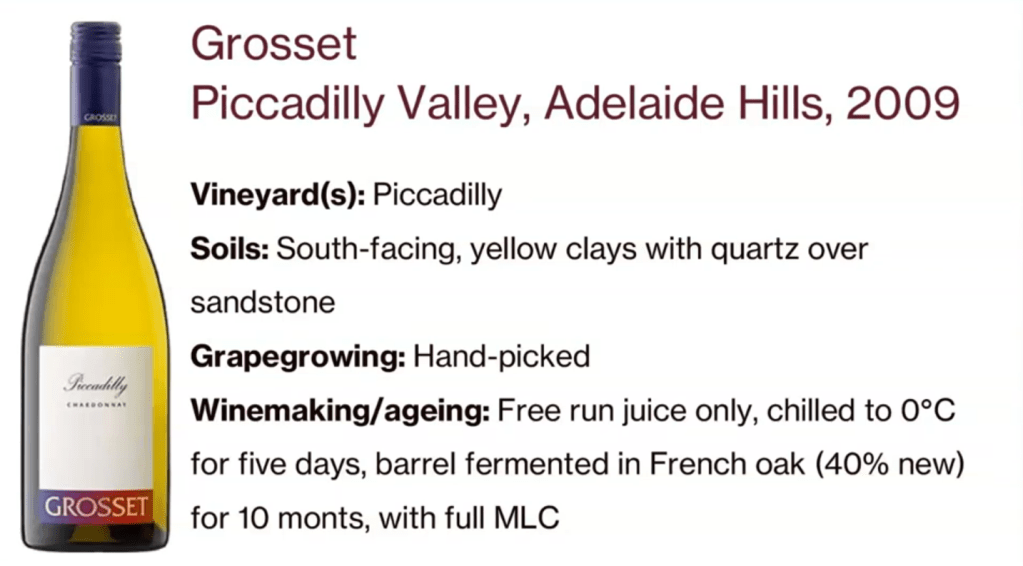
Grosset started in the 1980s mainly based in the Clare Valley. Renowned winemaker Jeffery Grosset embarked on a journey to craft exceptional wines and is famous for his Rieslings. This wine is from a very small vineyard in Piccadilly, Adelaide Hills which as only produced 300 cases (6 bottles per case). This vintage of 2009 had a wet winter but a brutal summer with a very bad heat wave. This makes the wine more powerful and dense with smoky oak notes not from the oak but from ageing. Also, there are tertiary notes of mushroom and fungal notes.
The journey has come along on with this online session so impressive! To experience different vintages as well as different areas is really special. It’s so interesting to see the transformation how much chardonnays have changed from the fuller bodied to the lighter more delicate bodied wines in the Adelaide Hills.
Chardonnay has always been a very mis understood grape variety for various reasons with the misconceptions of the ABC ‘anything but chardonnay’ ideology. So, Jimmy Smith organised an online tasting session on Aged Australian Chardonnays personally selected from his cellar, with vintages spanning from 2008 to 2020. Jimmy was joined by the iconic Emma Symington MW to showcase the journey and wines of Aged Australian Chardonnay consisting of 9 wines from 7 different wineries across three regions. I will be splitting this online session into three blogs focusing on Mornington Peninsula, Adelaide Hills and Margaret River. With Jimmy’s extensive knowledge in wine and Emma’s specialisation in wine Australia we were taken through the history of chardonnay which spanned over 3 decades.
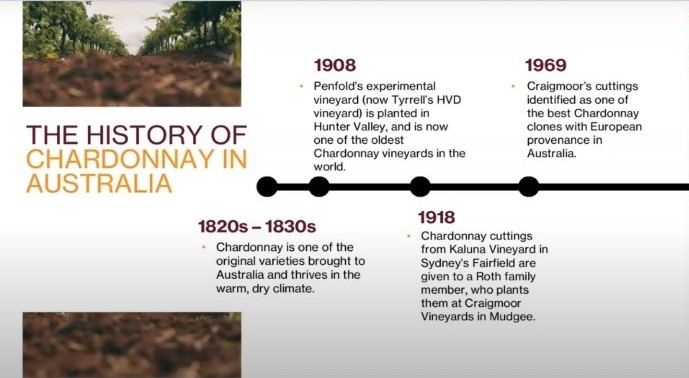
The History of Chardonnay in Australia
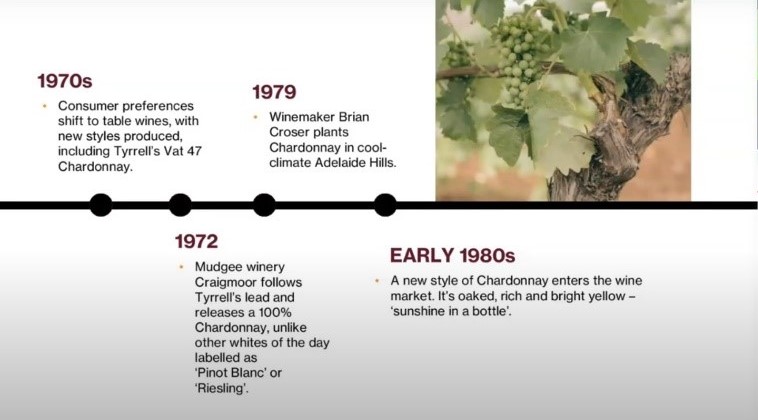
Australian viticulture was changed in the 1830s by the Scottish immigrant James Busby. He brought cuttings of the grape variety Chardonnay from France where it thrived with the warmer conditions. Through the 20th century Chardonnay was not seen on a wine label as it was typically blended or mislabelled as Riesling or Pinot Blanc as there were no strict labelling laws like there are today.
In 1908, Penfold’s winery (now Tyrrell’s HVD vineyard) planted an experimental vineyard in Hunter Valley. It is now one of the oldest Chardonnay vineyards in the world, phylloxera free and still a working vineyard.
From the 1970s, people were more aware of these grape varieties and chardonnay appeared on the 1st wine label in 1972 called ‘Vat 47 Chardonnay’. This wine put Australian on the map of winemaking as it made people sit up and take notice.
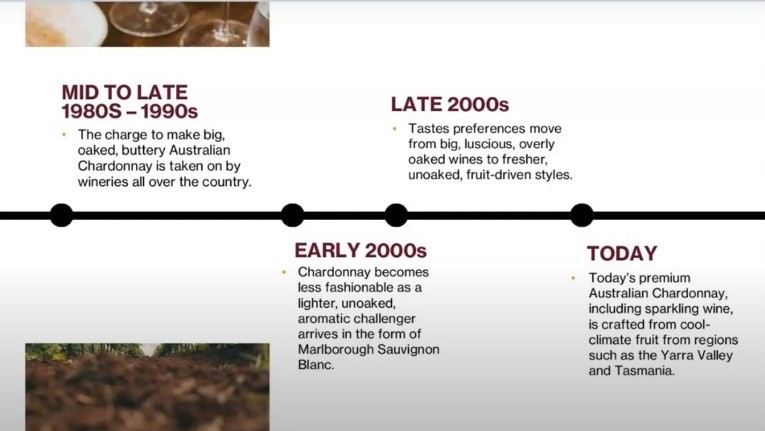
In the 1980’s a new style of chardonnay entered the wine market as an oaked, rich and bright yellow wine. Most of these wines were referred as ‘sunshine in a bottle’ with a cute animal on the label and butter wines which would fly off the shelves.
Unfortunately, the need for heavy oaked, buttery wines had faded when the new kid on the block grape variety had arrived from Marlborough, New Zealand: ‘Sauvignon Blanc.’ The market had shifted towards a lighter, unoaked aromatic wine putting chardonnay out of fashion. This was when the misconceptions of chardonnay has started to creep in and with the help of the media highlighting the ABC ‘anything but chardonnay’ ideology.
Things needed to change so the winemakers moved away from the heavy oaked buttery wines towards an unoaked fruity, elegant style chardonnay. This put chardonnay back in the running as some of the most desirable wines in the market.
Mornington Peninsula
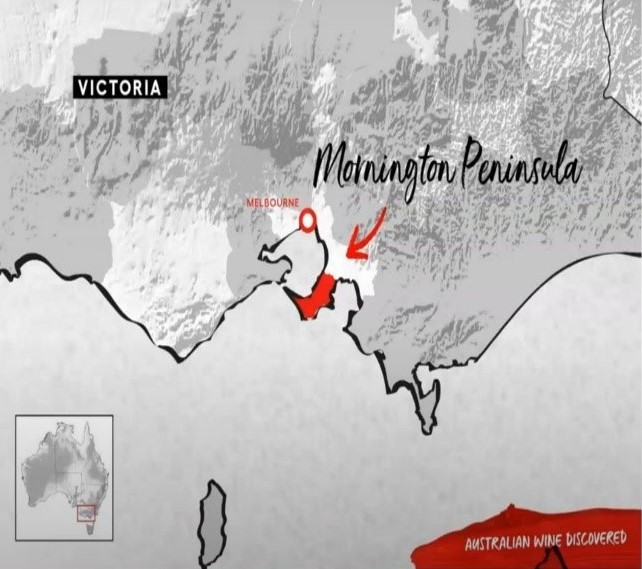
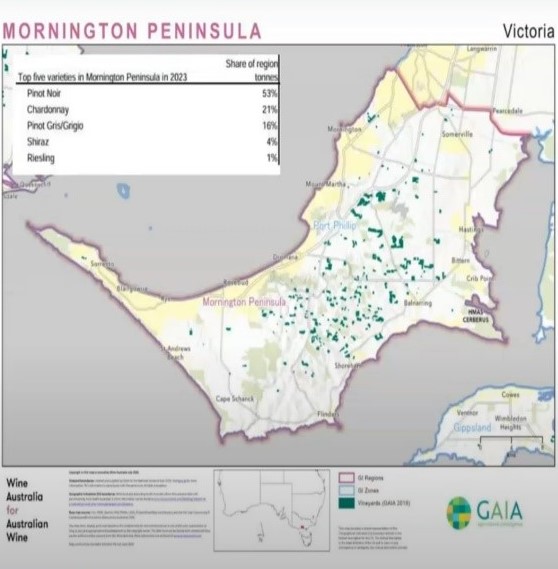
The peninsula has a lot of climatic influences of maritime, altitude and surrounded by Port Philip to the west, Western port to the east and Bass Strait to the south. The cool maritime climate provides ideal growing conditions with a low risk of spring frosts, a great air circulation from sea influences reducing the risk of fungal diseases. Mornington has approx. 900ha of vines spanning over around 200 vineyards, which are no more than 7KM away from the Ocean. This young wine region was started in 1973 when the first vines were planted. With this close communities of vineyards and wine makers, there are currently no big brands here making it small and mighty with plantings of mainly pinot noir and chardonnay.
The terroir of the peninsula consists of two categories, ‘Up the Hill’ (Red Hill) and ‘Down the Hill.’ Up the Hill is the red area on the map around Red Hill with influences from altitude of 250m and a composition of red basalt soils with good water retention which provides high vigour. Harvesting tends to be 2 weeks later than ‘Down the Hill’ making the chardonnays more delicate, high acidity with a saline style. ‘Down the Hill’ has a lower altitude with poorer lower in fertility soil (sedimentary brown/ grey loan) which is free draining. The sites are much warmer making chardonnay richer, fatty styles.
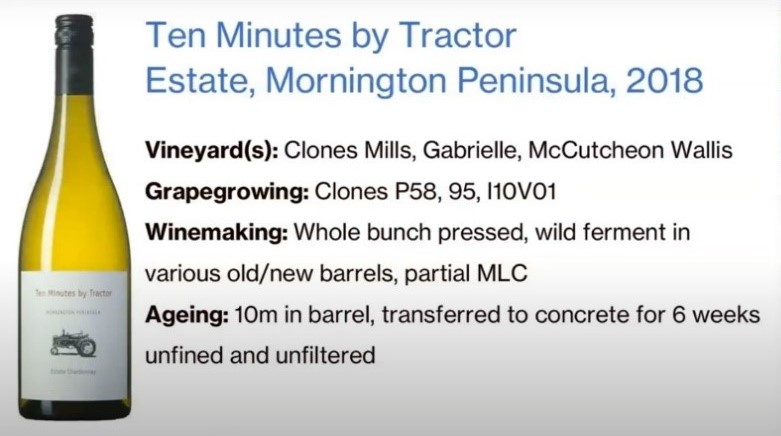
Wine No.1 – Ten Minutes by Tractor Estate, Morning Peninsula, 2018 (Up the Hill)
Ten Minutes by Tractor started its wine journey when three families; Judd, Wallis and McCutcheon, formed a co-operative to reduce costs and increase efficiency in 1997. Initially it was to share machinery, vineyard equipment and to employ a vineyard manager. The name: ‘Ten Minutes by Tractor’ was decided over a drink by the three families as they were literally ten minutes by tractor from each of their vineyards, and the name stuck.
This wine was not initially on Jimmy’s list for tonight’s masterclass, but he wanted to present a ‘stella’ wine for this region. This vintage of 2018 was a very wet winter and cool spring. This meant that the bud burst as late. It did lead into a warm good quality growing season with an early harvest with the shortest ever time between bud burst and harvest. This wine has a high acidity, delicate and light style with a briskness on the palette. A very interesting fact about this wine that is has 62% MLF and still displays high acidity. This wine would really blossom with age for another 5-10 years keeping it complexity and intensity fruit characteristics.
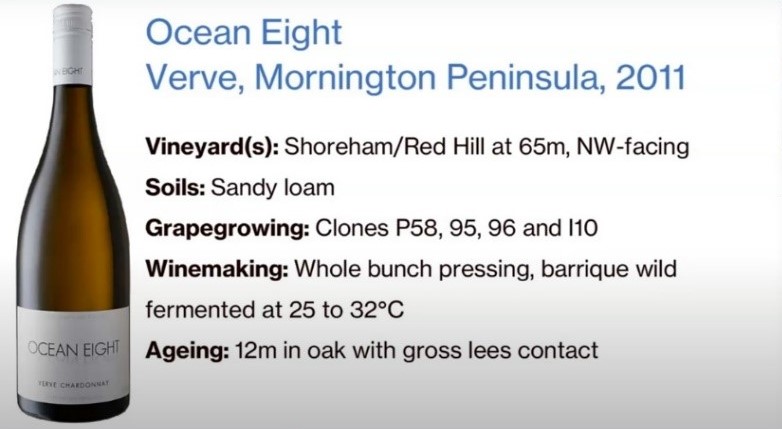
Wine No.2 – Ocean Eight Verve, Mornington Peninsula, 2011 (Middle of the Hill 65m)
Ocean Eight is managed by Micheal & Hollie Aylward using their knowledge of visiting vineyards and cellars of Burgundy, France to develop their style of wine. Micheal always returns to two ideas he has worked with since the 1st vintage:
1. How well the wines will match with food?
2. Will the wines best represent the climate and growing conditions of Mornington Peninsula?
This wine represents a leaner style than the typical chardonnays previously produced. Shoreham vineyard has 65m altitude at the middle of the hill giving a tight acidity. The 2011 vintage was a very wet/cool year with a cool summer. Mostly this vintage in Victoria was a write off and Ocean Eight set the way for producing such a lighter, mineral Chablis style chardonnay. Although this wine has a lightness about it, there is a nutty/ honey notes in the background.
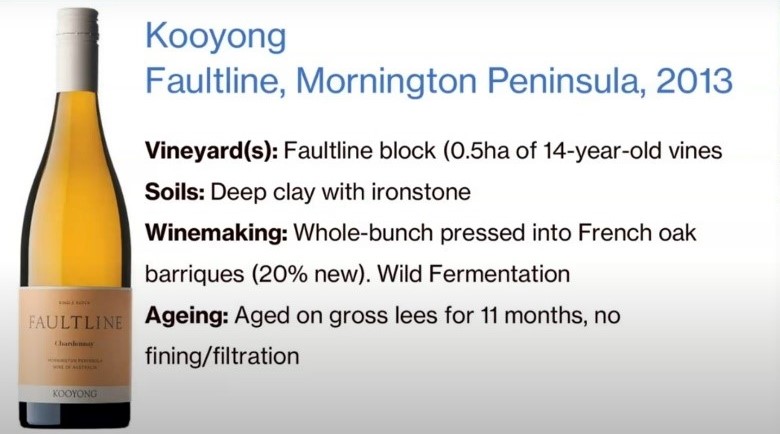
This wine was the catalyst for Jimmy to organise this wine event. Kooyong is owned by Giorgio and Dianne Gjergia, releasing their first wines in 2001. This single block estate ‘Down the Hill’ with ironstone clay.
This wine is riper, fattier/ nutty walnut note mainly due being in a warmer location of the hill. The 2013 was the wettest winter in 20 years, although the summer was very dry.
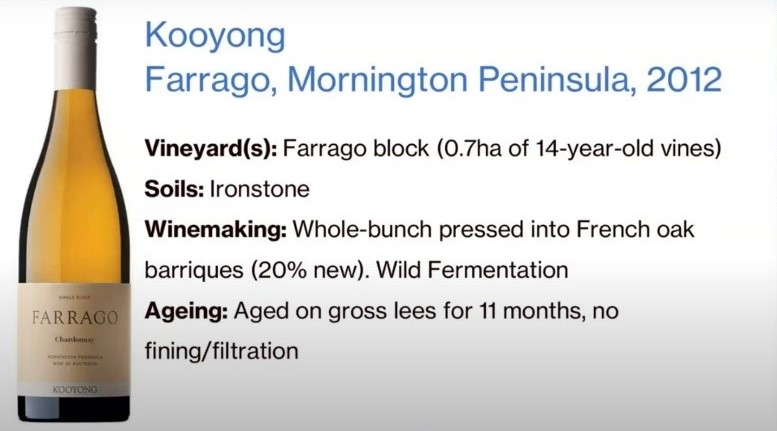
The second wine from Kooyong is also from a single vineyard and at the bottom of the hill not too far from the ‘Faultline’ vineyard which has ironstone soil. These are 14-year-old vines with a lighter/ mineral feel. There are notes of blossom and cashew nut.
This year was not as cool or wet as 2011, but it did have a damp spring.
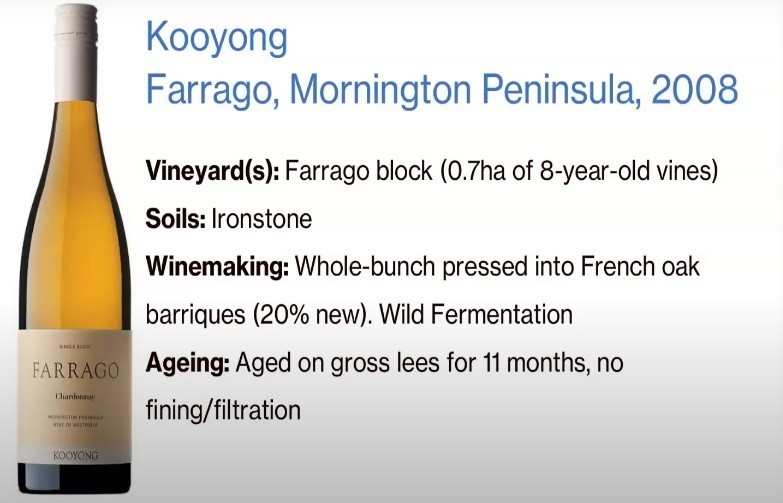
The final wine from this winery is a much older vintage of 2008. This vintage had a dry season with warmer than average spring and summer. This is the same block as Farrago but has much younger vines of 8 years. Do not be fooled with the age of the vines as there is distinct tertiary notes of mushroom and Brazil nut with the being richer and fattier.
The journey of going through the different vintages in Mornington Peninsula from 2008 all the way up to 2018 was so fascinating. Exploring the difference in terroir of Red Hill, with wines from ‘Up the Hill’ and ‘Down the Hill.’ The different climatic changes in rainfall can really affect the wine making them leaner and more acidic.

 Sharing my wine knowledge